Best Screenshot Tools for Mac
Compare the best screenshot tools for Mac based on capture speed, annotation features, and how well they handle modern communication workflows.
Mac users already have built-in screenshot shortcuts, so a screenshot tool has to do more than simply capture the screen. The real question is how much time it saves after the screenshot exists.
That is where screenshot tools separate themselves.
This guide is for Mac users comparing screenshot tools because the default workflow no longer feels fast enough. Use it to judge whether you need basic capture, occasional markup, or a workflow-first app that keeps screenshots easy to copy, edit, drag, rename, and clean up after every capture.
What to look for in a Mac screenshot tool
A good screenshot tool should improve at least one of these areas:
- access to recent screenshots
- speed of copying and sharing
- annotation tools
- file management
- drag-and-drop workflows
- support for daily work, not just occasional capture
If a tool only duplicates Command + Shift + 3 or Command + Shift + 4, it probably is not giving you much value.
Types of screenshot tools on Mac
There are roughly three categories.
1. Built-in macOS screenshot tools
These are the default shortcuts and the screenshot toolbar. They are already good for simple capture.
Best for:
- casual users
- occasional screenshots
- people who do not need editing or repeated sharing
Tradeoff:
The post-capture workflow is limited.
2. Screenshot annotation tools
These focus on making screenshots clearer with arrows, highlights, text, and shapes.
Best for:
- product feedback
- QA and bug reporting
- tutorials and docs
Tradeoff:
Some tools are strong at annotation but weak at organization or repeat workflows.
3. Workflow-first screenshot tools
These tools focus on what happens after capture: visibility, actions, sharing, and speed.
Best for:
- developers
- founders
- PMs
- designers
- support and operations teams
Tradeoff:
You need a tool that stays out of the way and works with your existing capture habits.
What matters more now than a few years ago
Screenshots have become part of everyday communication. They are not just reference files anymore.
People now use screenshots to:
- explain bugs
- communicate UI changes
- create async feedback loops
- ask AI tools for help
- give support or onboarding instructions
That means the best screenshot tool is not necessarily the one with the most editing power. It is the one that helps you get from capture to communication fastest.
Where built-in macOS tools still win
macOS wins on simplicity. Nothing is faster to start with than:
Command + Shift + 3Command + Shift + 4
If that is all you need, you may not need anything else.
Where dedicated tools win
Dedicated tools become valuable when you take screenshots often enough that the friction compounds.
Common friction points:
- screenshots disappear before you act on them
- filenames are generic
- editing requires another app
- sharing means opening Finder
- dragging several screenshots into another tool is awkward
If those things happen every day, even a small improvement saves real time.
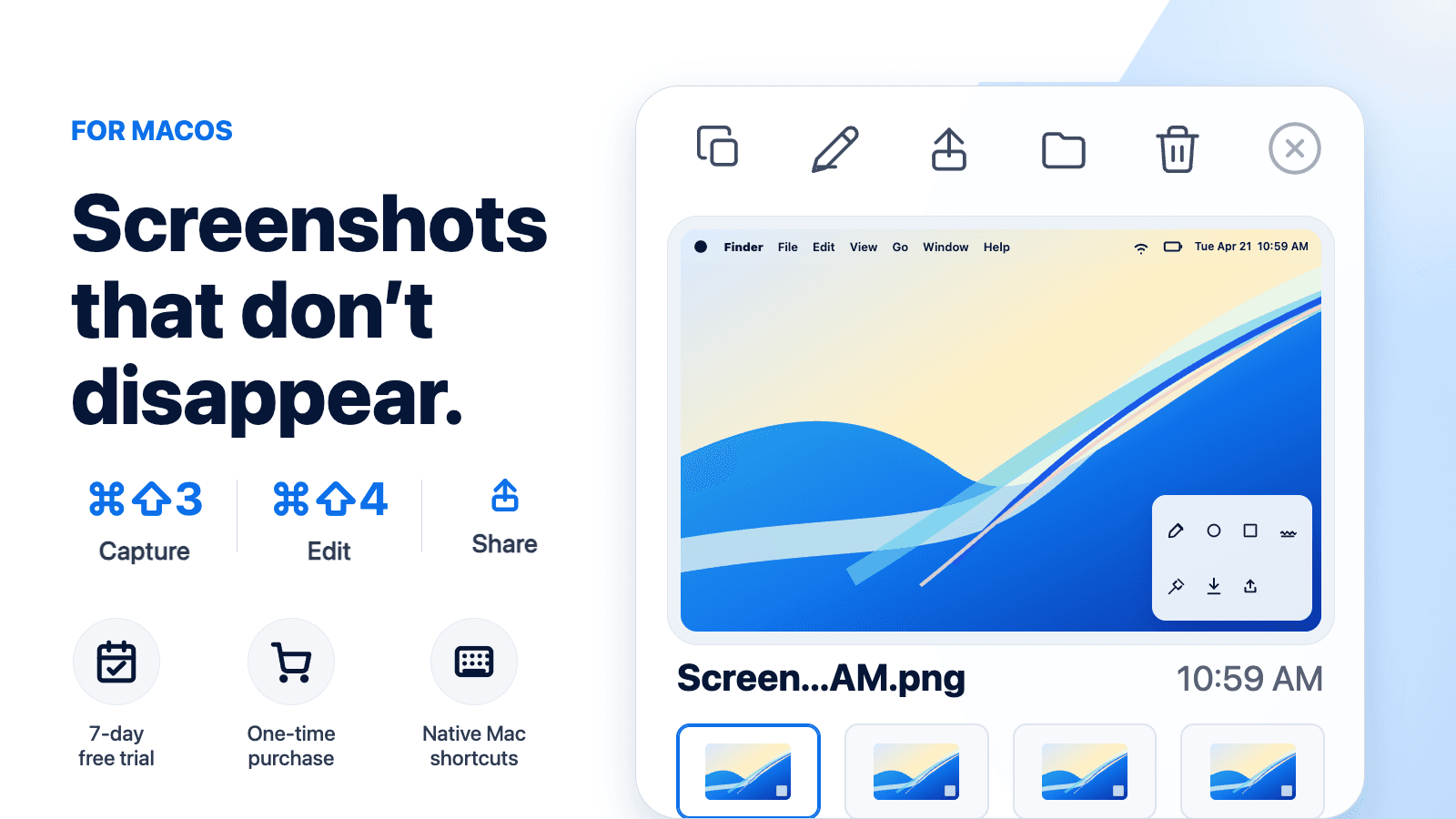
Why CommandShot is different
CommandShot focuses on improving the default Mac screenshot workflow without changing how screenshots are taken.
That means:
- keep using the same shortcuts
- keep screenshots visible after capture
- copy, paste, rename, delete, or share immediately
- open the editor only when needed
- drag multiple screenshots into Slack, email, Notion, or AI tools
It is a workflow improvement more than a capture replacement.
Final takeaway
The best screenshot tool for Mac depends on how often screenshots show up in your work.
- For basic capture, macOS is enough.
- For occasional markup, built-in tools may still be fine.
- For heavy daily screenshot workflows, a workflow-first tool saves the most time.
That is the lens worth using when you compare options: not "Can it take screenshots?" but "How fast does it help me finish with the screenshot?"