Where Do Screenshots Go on Mac?
Find where Mac screenshots are saved, how to change the screenshot folder, and what to do when screenshots feel hard to locate after capture.
Knowing where screenshots go on Mac sounds simple until you actually need one fast. You take a screenshot, the thumbnail appears for a few seconds, and then it is gone. If you are in the middle of writing a bug report, sending a customer reply, or pasting an image into ChatGPT, that small interruption can turn into a hunt through Finder.
This guide explains where Mac screenshots are saved by default, how to find them when they are not on your Desktop, and how to make the whole workflow easier if screenshots are part of your daily work.
The default Mac screenshot location
By default, screenshots taken with the standard Mac shortcuts are saved to the Desktop.
The main shortcuts are:
Command + Shift + 3for the whole screenCommand + Shift + 4for part of the screenCommand + Shift + 4, thenSpacefor a windowCommand + Shift + 5for the Screenshot toolbar
Apple's own Mac screenshot guide also notes that screenshot files are saved as PNG files and their names begin with "Screenshot" or "Screen Recording" plus the date and time.
That naming is useful for avoiding duplicate files, but it is not very helpful when you need to identify a screenshot by project, customer, bug, or conversation.
Why screenshots may not be on your Desktop
If your screenshots are not showing up on the Desktop, the most common reason is that the save location was changed.
To check it:
- Press
Command + Shift + 5. - Click
Options. - Look under
Save To. - Check whether Desktop, Documents, Clipboard, Preview, Mail, Messages, or another folder is selected.
If Other Location was chosen at some point, your screenshots may be saving into a custom folder. That can be useful, but it also makes screenshots feel like they disappeared if you forgot where that folder is.
How to find recent screenshots on Mac
If you are not sure where a screenshot went, try these checks:
- Look on the Desktop for a file that starts with "Screenshot".
- Open Finder and search for
Screenshot. - Sort by date modified so the newest files appear first.
- Check the folder selected in
Command + Shift + 5underOptions. - If you copied to clipboard, paste into the app where you wanted to use the screenshot.
The clipboard case is especially easy to miss. If you used a shortcut with the Control key, macOS may have copied the screenshot instead of saving it as a visible file.
How to change where screenshots go on Mac
Use the Screenshot toolbar:
- Press
Command + Shift + 5. - Click
Options. - Choose a preset location, or choose
Other Location. - Take your next screenshot.
This is the cleanest way to change the screenshot folder without needing anything complicated.
Good save locations include:
- Desktop, if you want screenshots to be immediately visible
- Documents, if screenshots are part of work files
- a dedicated Screenshots folder, if you take many screenshots
- Clipboard, if you mostly paste screenshots into messages or documents
The best location depends on what happens after capture. If screenshots are just temporary communication, the Desktop can get messy fast. If screenshots need to be kept for records, a dedicated folder may make more sense.
Why the floating thumbnail can be confusing
After you take a screenshot, macOS may show a floating thumbnail in the bottom-right corner. Apple describes this thumbnail as a way to drag, mark up, or share the screenshot before it is saved to the selected location.
The confusing part is that the thumbnail only stays for a short time. If it disappears, the screenshot is usually not gone. It has normally been saved to the location selected in the Screenshot toolbar.
Still, that short window creates friction. You may want to drag the screenshot into Slack, paste it into an email, or rename it while the context is still fresh. If the thumbnail disappears first, you are back in Finder.
What to do if screenshots keep cluttering your Desktop
If your Desktop fills up with screenshots, try this workflow:
- Create a folder named
Screenshots. - Set it as the save location in
Command + Shift + 5underOptions. - Rename important screenshots immediately.
- Delete temporary screenshots after sending them.
- Use clipboard shortcuts for screenshots you do not need to keep.
This works well if you only take screenshots occasionally. If you take screenshots constantly, the bigger issue is not just storage. It is the extra work after each capture.
The better question: what do you need to do with the screenshot?
People ask where screenshots go because they usually need to do something with the file:
- paste it into a chat
- attach it to a support ticket
- mark it up for a bug report
- drag it into a document
- upload it into an AI tool
- rename it so it makes sense later
The default Mac workflow can do all of that, but it often makes you switch into Finder first. That switch is what slows the work down.
A faster post-screenshot workflow
For daily screenshot work, a smoother flow looks like this:
- Take the screenshot with the shortcuts you already know.
- Keep the recent screenshot visible.
- Act on it immediately: copy, edit, rename, drag, share, or delete.
- Move on before the context disappears.
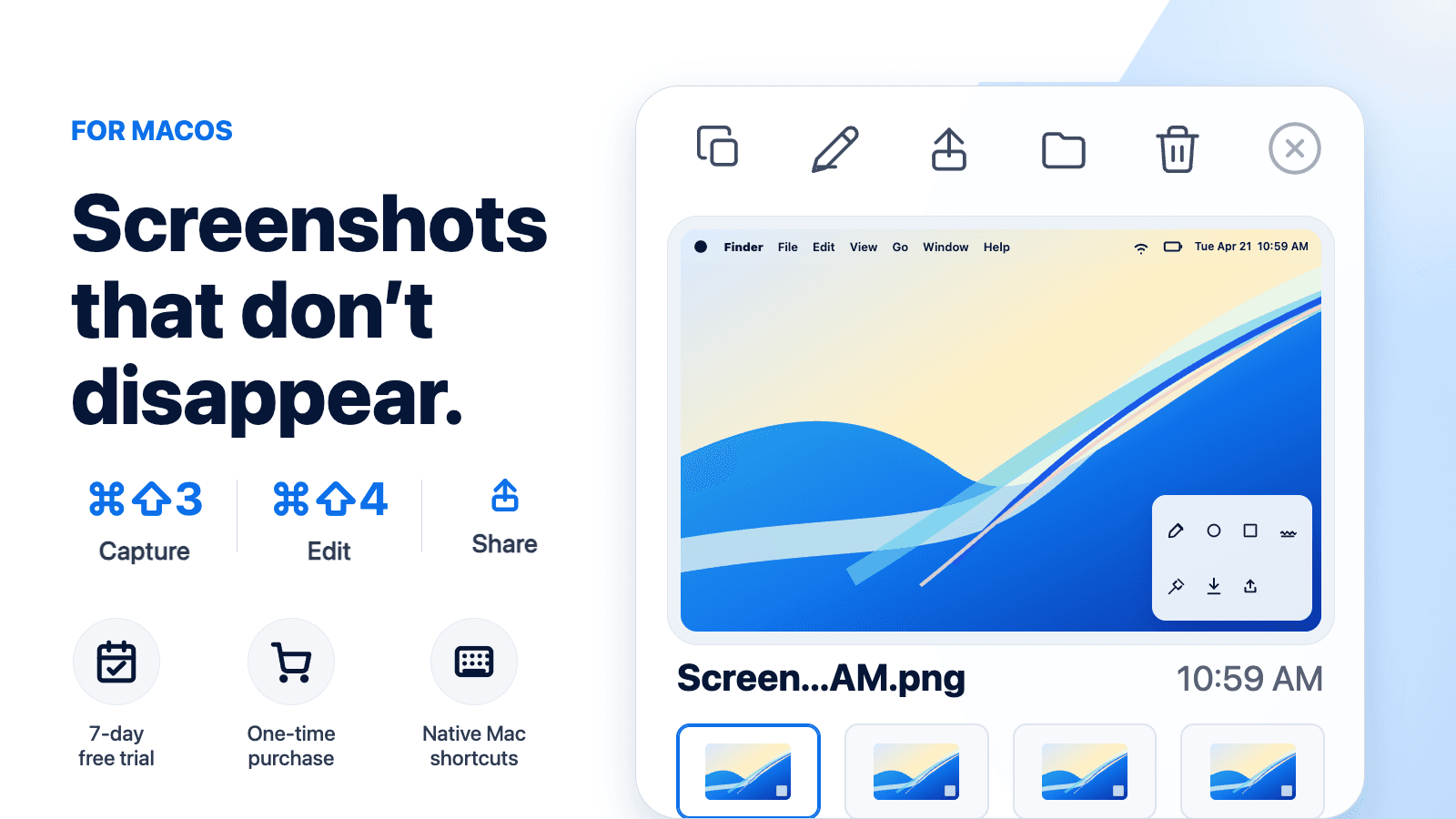
That is the gap CommandShot is built around. It does not ask you to relearn Mac screenshots. It keeps the screenshot ready after capture so the next action is easy.
Final takeaway
Mac screenshots usually go to the Desktop, but that depends on the save location selected in the Screenshot toolbar. If you cannot find yours, press Command + Shift + 5, open Options, and check Save To.
If you take screenshots all day, finding the folder is only the first step. The real productivity gain comes from making screenshots easier to use right after you take them.