Snipping Tool for Mac: The Mac Equivalent and Better Workflows
Find the Mac equivalent of Windows Snipping Tool, learn the fastest Mac snipping shortcuts, and make screenshots easier to edit and share.
If you came from Windows and searched for a Snipping Tool for Mac, the answer is simpler than it seems: macOS already has the core snipping features built in. Apple just calls them screenshots instead of snips.
You can capture the whole screen, select a custom area, grab one window, or open a toolbar with extra options. The built-in tools are strong for basic capture. The place most people still lose time is after the snip: finding the file, copying it, editing it, renaming it, and sending it somewhere useful.
The Mac equivalent of Snipping Tool
The Mac equivalent of Snipping Tool is the Screenshot app and its keyboard shortcuts. For most people, the most useful shortcut is Command + Shift + 4 because it lets you drag over exactly the part of the screen you want.
Here is the quick map:
| What you want to do | Mac shortcut | Best use case |
|---|---|---|
| Snip part of the screen | Command + Shift + 4 | Errors, UI details, messages, charts, forms |
| Open screenshot options | Command + Shift + 5 | Timer, save location, recordings, toolbar choices |
| Capture the whole screen | Command + Shift + 3 | Full-page context, complete desktop state |
| Capture one window | Command + Shift + 4, then Space | Clean app-window screenshots |
Apple's screenshot guide for Mac covers the built-in options, including capturing the full screen, a window, or a selected portion.
How to snip part of the screen on Mac
This is the closest match to the Windows Snipping Tool rectangle capture:
- Press
Command + Shift + 4. - Drag over the area you want to capture.
- Release the mouse or trackpad.
- Look for the saved screenshot or floating thumbnail.
Use this when you want to capture only the important part of the screen. It is ideal for a specific error message, design detail, form state, chart, receipt, settings panel, or section of a web page.
The main advantage is focus. A partial screenshot is usually easier for someone else to understand than a full desktop capture with unrelated windows, notifications, and background clutter.
How to capture a window
If you want a clean window screenshot:
- Press
Command + Shift + 4. - Press
Space. - Move the camera pointer over the window.
- Click the window.
This is useful when you want the whole app window but not the rest of the desktop.
How to use the full Screenshot toolbar
Press Command + Shift + 5.
The toolbar gives you more control. You can choose:
- full screen capture
- window capture
- selected portion capture
- full screen recording
- selected portion recording
- save location
- timer
- floating thumbnail setting
If you are still learning Mac screenshots, the toolbar is easier because the options are visible. Once the shortcuts are familiar, Command + Shift + 4 is usually faster for everyday snips.
Where Mac snips are saved
Mac screenshots usually save to the Desktop unless the save location has been changed. If you take a snip and cannot find it, check the Screenshot toolbar:
- Press
Command + Shift + 5. - Click
Options. - Look under
Save To.
If the screenshot is not on your Desktop, the save location may be set to Documents, Clipboard, Preview, Mail, Messages, or a custom folder. For a deeper walkthrough, read the guide to where screenshots go on Mac.
How to copy a Mac snip instead of saving it
Add Control to the shortcut.
Use:
Control + Command + Shift + 4to copy a selected areaControl + Command + Shift + 3to copy the full screen
Then paste with Command + V.
This is excellent for quick sharing because it skips the saved-file step. It can also be confusing if you expected a file to appear on your Desktop. For more detail, read the guide to copying screenshots to clipboard on Mac.
When the built-in Mac snipping tool is enough
The built-in tool is enough when you:
- take screenshots occasionally
- only need basic capture
- do not need repeated annotation
- do not need to manage many screenshots
- are comfortable finding saved files on the Desktop
For light use, macOS gives you a strong starting point. There is no reason to add a new app if all you need is an occasional screenshot.
When you may want a dedicated screenshot app
A dedicated screenshot app starts to matter when the work starts after the capture.
You may want one if you often need to:
- annotate screenshots with arrows, boxes, highlights, or text
- keep recent screenshots visible
- drag screenshots into other apps
- rename screenshots before sharing
- delete temporary screenshots quickly
- copy the same screenshot into several places
- avoid a cluttered Desktop
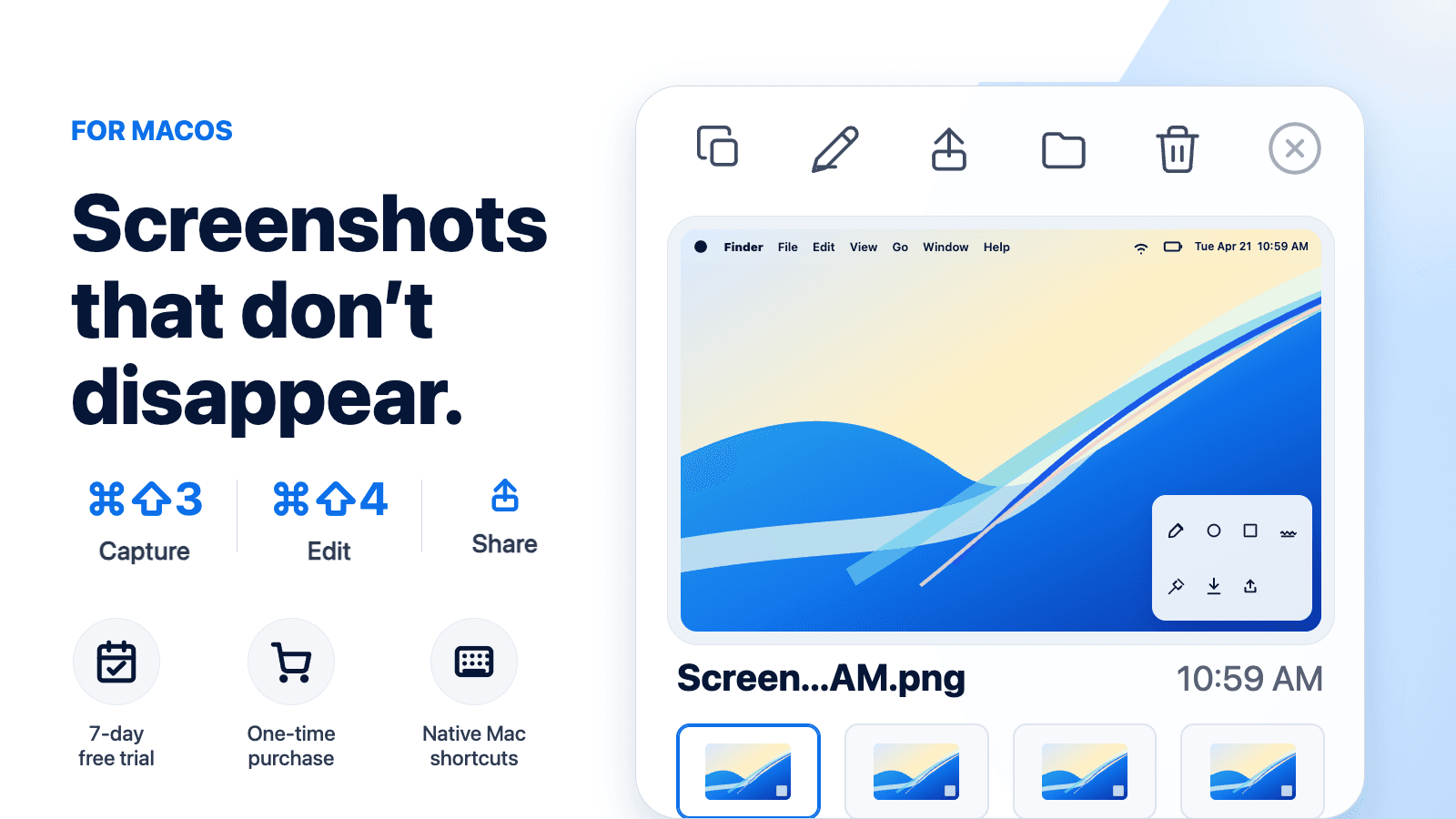
That is where a tool like CommandShot fits. It does not replace the Mac screenshot shortcuts. It improves the moment after the shortcut, when you need to actually use the image.
A practical snipping workflow for Mac
For day-to-day work, try this:
- Use
Command + Shift + 4for focused captures. - Capture slightly more context than the exact issue.
- Rename important screenshots right away.
- Add an arrow or highlight if one detail matters.
- Paste or drag the screenshot into the destination.
- Delete throwaway screenshots once shared.
This keeps screenshots useful instead of letting them pile up as unnamed files.
Final takeaway
The Mac version of Snipping Tool is the built-in Screenshot app. Use Command + Shift + 4 to snip part of the screen, Command + Shift + 5 for the toolbar, and Control when you want the snip copied to the clipboard.
If screenshots are part of your daily work, the capture shortcut is only step one. A better workflow keeps the snip ready for the next action.