Command + Shift + 3 vs Command + Shift + 4
Understand when to use the full-screen Mac screenshot shortcut versus the partial screenshot shortcut, and why most work benefits from selective capture.
On Mac, Command + Shift + 3 and Command + Shift + 4 are the two screenshot shortcuts most people use. They look similar, but they solve different problems.
If you use screenshots for work, choosing the right shortcut saves time before you even start editing.
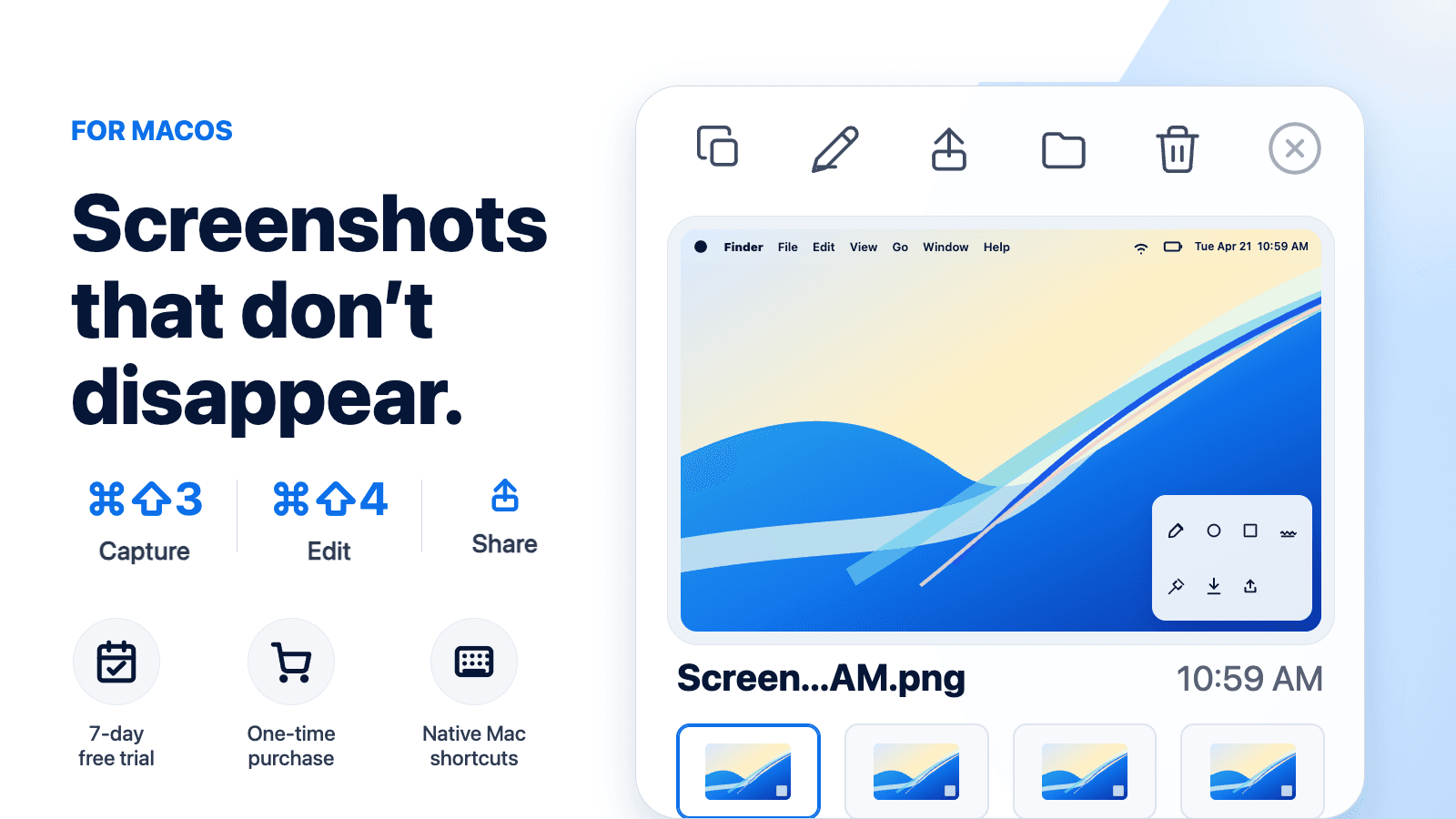
This comparison is for people who already know both shortcuts exist but want a practical rule for daily screenshot work. After you choose full-screen or partial capture, the next step is making the image usable quickly; CommandShot keeps that capture visible so you can copy, edit, rename, drag, share, or delete it without hunting through Finder.
What Command + Shift + 3 does
Command + Shift + 3 captures your entire screen.
Use it when:
- the full screen is the point
- you need the complete context
- you are archiving exactly what happened
Examples:
- a full desktop state
- a large visual layout
- a full browser page without selecting a smaller region
This shortcut is simple and fast. Press it and the screenshot is taken immediately.
What Command + Shift + 4 does
Command + Shift + 4 lets you choose a specific region of your screen.
Use it when:
- only part of the screen matters
- you want a cleaner screenshot
- you are sending the image to another person
Examples:
- a bug in a modal
- a chart or graph
- a specific UI component
- a payment error or warning state
This shortcut usually creates more useful screenshots because it trims away clutter before the file is created.
Which shortcut is better?
Neither shortcut is universally better. The better one is the one that preserves the right amount of context.
Choose Command + Shift + 3 when:
- the whole screen matters
- you do not want to miss anything
- you are capturing a broad system state
Choose Command + Shift + 4 when:
- attention should go to one area
- you want smaller, clearer images
- you plan to paste the screenshot into chat, email, or an issue tracker
For most everyday work, Command + Shift + 4 is the stronger default. It creates screenshots that are easier to scan and easier to act on.
Why partial screenshots often communicate better
A full-screen screenshot includes everything:
- browser chrome
- menu bar
- desktop clutter
- unrelated side panels
- other windows
Sometimes that extra context is useful. Often it just makes the important part harder to notice.
Partial screenshots reduce that problem at the source. Instead of capturing noise and cleaning it up later, you capture only what matters.
That becomes especially important in:
- design feedback
- bug reports
- product reviews
- support conversations
- AI prompt workflows
A practical rule of thumb
Ask one question before you capture:
Is the entire screen necessary to understand the issue?
If yes, use Command + Shift + 3.
If no, use Command + Shift + 4.
That one decision makes most screenshot workflows cleaner.
What both shortcuts still have in common
Whether you use Command + Shift + 3 or Command + Shift + 4, macOS still gives you the same follow-up friction:
- the preview disappears quickly
- renaming takes extra work
- editing means opening another tool
- sharing often starts in Finder
So the question is not only which shortcut to use. It is also how you handle the screenshot once it exists.
Best use cases for each shortcut
Here is a simple breakdown:
Use Command + Shift + 3 for:
- full desktop captures
- system settings
- layout comparisons
- anything where cropping might hide useful context
Use Command + Shift + 4 for:
- UI bugs
- app feedback
- support screenshots
- tutorial callouts
- AI conversations where precision matters
Final takeaway
Command + Shift + 3 is best for full context.
Command + Shift + 4 is best for focused communication.
If you take screenshots all day, both shortcuts are worth keeping in muscle memory. The better workflow is not about replacing either one. It is about using the right shortcut, then making the screenshot immediately usable without extra cleanup.