How to Edit a Screenshot on Mac
Edit, crop, annotate, and share Mac screenshots using built-in tools or a faster screenshot workflow built for daily work.
Taking a screenshot on Mac is easy. Editing it clearly is where the workflow can slow down.
Sometimes all you need is a quick crop. Other times you need an arrow, highlight, box, or short label so the person receiving the screenshot knows exactly what to look at. This guide covers the built-in Mac options first, then a faster workflow for people who edit screenshots often.
Edit from the floating thumbnail
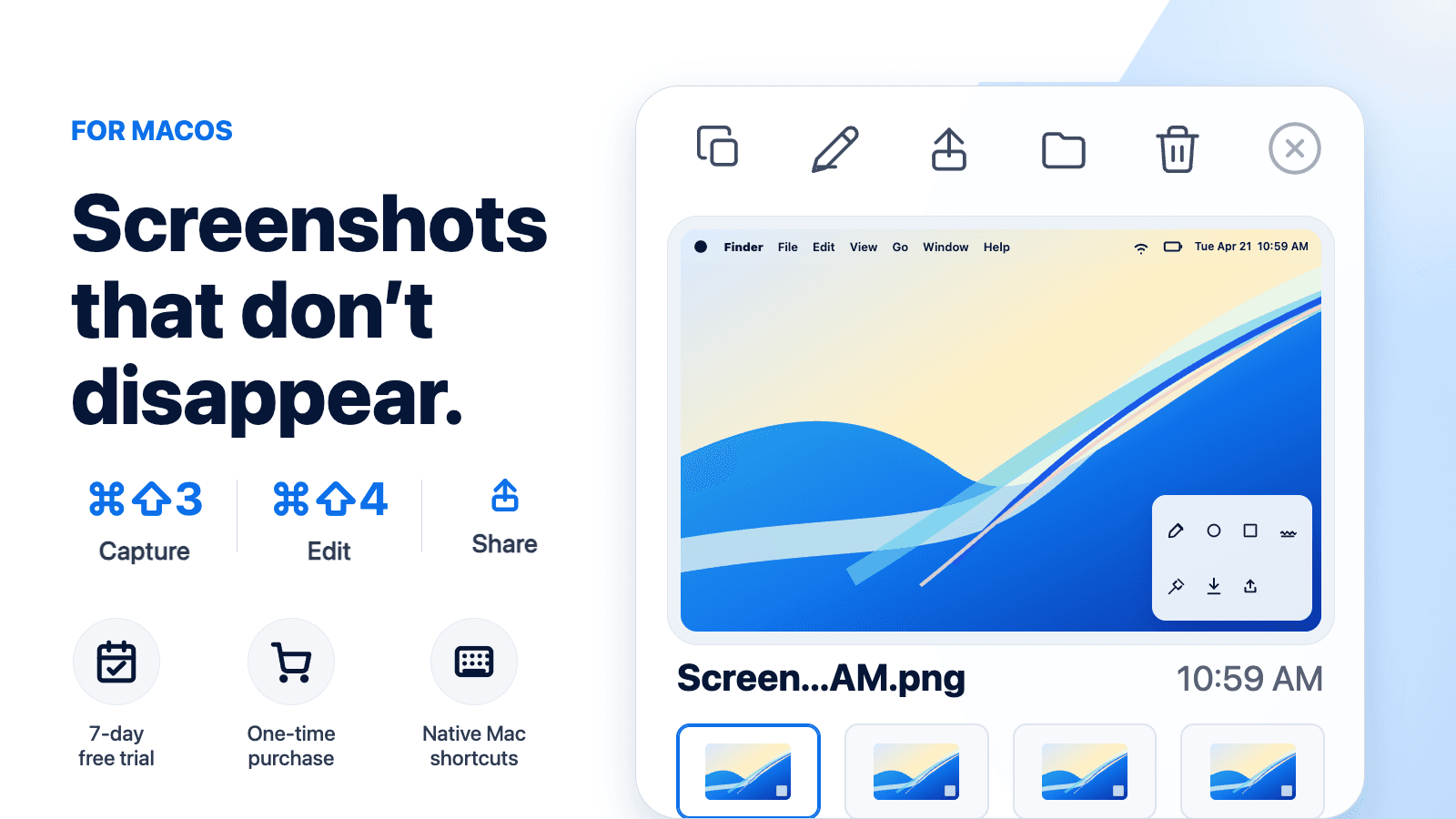
After you take a screenshot, macOS may show a floating thumbnail in the bottom-right corner. Click it before it disappears to open the screenshot in a Markup window.
From there, you can usually:
- crop the image
- draw shapes
- add text
- add arrows or lines
- highlight an area
- share the screenshot
Apple's Screenshot guide explains that the floating thumbnail can be clicked to mark up or share the screenshot before it is saved.
This is the fastest built-in route if you catch the thumbnail in time.
Edit a screenshot in Preview
If the screenshot is already saved:
- Find the screenshot file.
- Open it in Preview.
- Click the Markup button.
- Add the edit you need.
- Save or export the image.
Preview is good for simple edits. It is especially useful for cropping, adding text, and drawing basic shapes.
The weak point is the setup time. You need to find the file, open it, edit it, save it, then send it where it needs to go.
How to crop a screenshot on Mac
The simplest built-in method is Preview:
- Open the screenshot in Preview.
- Drag to select the part you want to keep.
- Choose
Tools, thenCrop. - Save the file.
If you have not taken the screenshot yet, it is often better to capture a smaller area with Command + Shift + 4 instead of cropping afterward.
Cropping before capture keeps the file cleaner and avoids extra editing.
How to annotate a screenshot on Mac
Good annotation is not about adding a lot of markup. It is about reducing confusion.
Use:
- an arrow when one thing matters most
- a box when an area matters
- a highlight when text or a row matters
- short text labels when the screenshot needs context
- crop when unrelated UI distracts from the issue
Avoid adding too many arrows or labels. If a screenshot needs six annotations, it may be better to send two focused screenshots instead.
How to edit screenshots for bug reports
For bug reports, the screenshot should make the issue obvious.
Before sending it, check:
- Does the screenshot show the broken state?
- Is there enough surrounding context?
- Is private information hidden or cropped out?
- Is the bug marked with an arrow, box, or highlight?
- Is the filename useful if someone downloads it later?
Screenshots are most useful when they reduce follow-up questions.
How to edit screenshots for AI prompts
Screenshots can be very useful in AI tools, but they need focus.
When preparing a screenshot for ChatGPT or another AI tool:
- crop out unrelated desktop clutter
- include enough context around the issue
- add one arrow or label if the point is specific
- avoid tiny text if possible
- pair the image with a clear question
For more detail, read the guide to taking screenshots for ChatGPT.
When built-in editing is enough
Built-in tools are enough when:
- you edit screenshots occasionally
- the floating thumbnail gives you enough time
- you only need simple crop or markup
- you do not take many screenshots in a row
There is no need to overcomplicate a simple task.
When a dedicated screenshot editor helps
A screenshot editor helps when screenshots are a regular part of communication.
You may benefit from a dedicated workflow if you often:
- miss the floating thumbnail
- open Finder just to find the latest screenshot
- annotate several screenshots per day
- drag screenshots into chat, docs, tickets, or AI tools
- rename screenshots before sharing
- clean up screenshots after sending them
In that case, the edit itself is not the only issue. The whole path from capture to done needs to be faster.
A clean editing workflow
Try this simple rule: edit only enough to make the screenshot understandable.
- Capture the smallest useful area.
- Crop if anything unrelated remains.
- Add one clear annotation.
- Rename the screenshot if it will be kept.
- Send it.
- Delete it if it was temporary.
That keeps screenshots helpful without turning every capture into a design task.
Final takeaway
To edit a screenshot on Mac, click the floating thumbnail right after capture or open the saved image in Preview and use Markup. For occasional edits, that is enough.
If screenshot editing is part of your everyday workflow, the bigger improvement is keeping recent screenshots visible and ready to edit, copy, rename, or share without digging through Finder.