How to Take a Screenshot on Mac
Learn the default Mac screenshot shortcuts for full-screen, partial, and window captures, plus how to make screenshots easier to manage.
If you want to take a screenshot on a Mac, the good news is that you usually do not need to install anything. macOS already includes built-in screenshot shortcuts, and once you know them, capturing your screen becomes second nature.
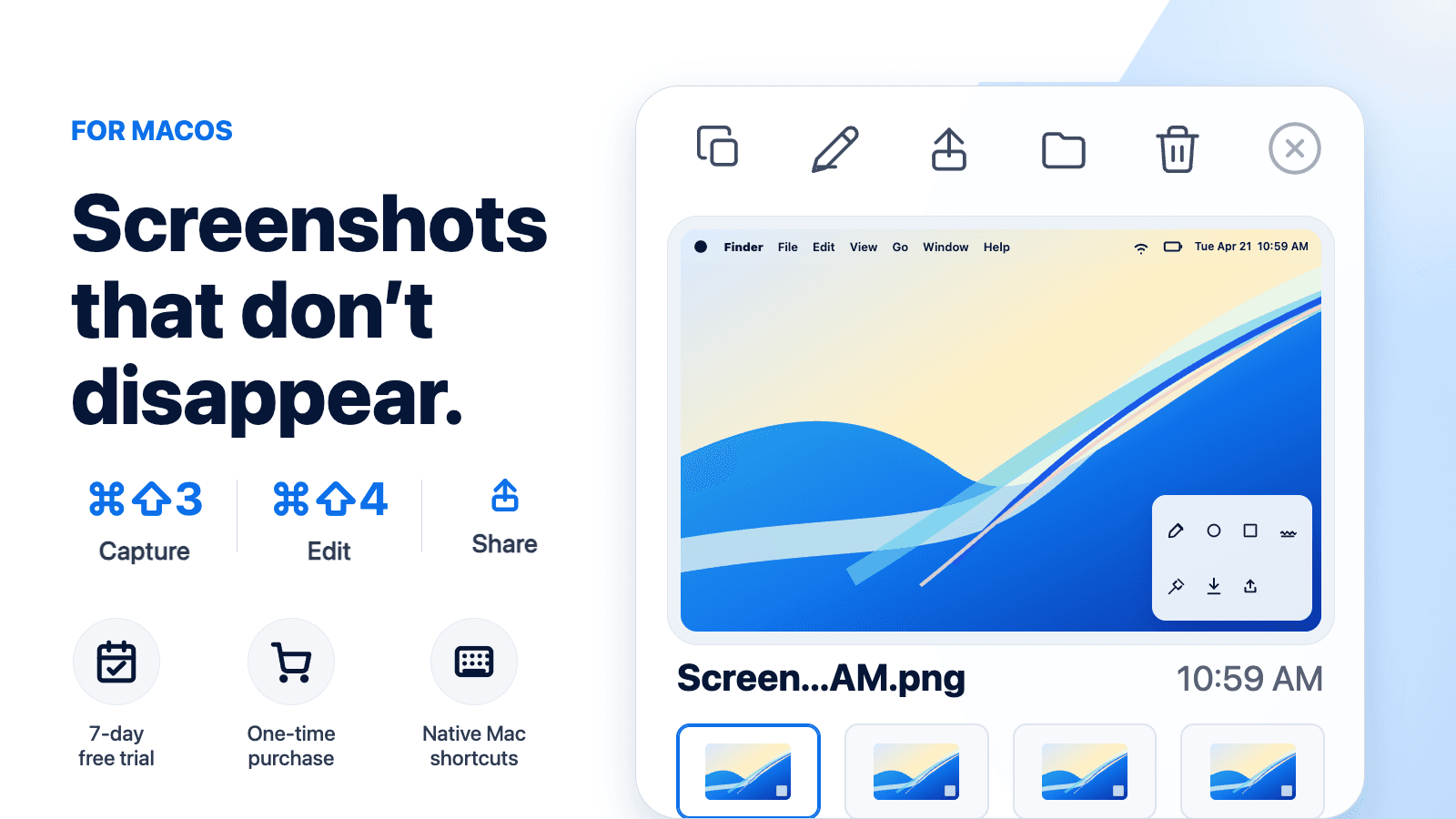
The part that tends to slow people down is not taking the screenshot. It is what happens after. The file appears for a moment, disappears, and then you have to hunt through Finder to rename it, copy it, annotate it, or send it somewhere.
This guide covers the core screenshot shortcuts first, then the small workflow details that make screenshots faster to use in real work.
The main Mac screenshot shortcuts
There are three default shortcuts most Mac users should know:
Command + Shift + 3captures your entire screen.Command + Shift + 4lets you select part of your screen.Command + Shift + 5opens the screenshot toolbar for more options.
If you only remember two shortcuts, remember Command + Shift + 3 and Command + Shift + 4. Those cover the majority of screenshot tasks.
How to capture your entire screen
Press Command + Shift + 3.
macOS will immediately capture everything visible on your display. If you use multiple monitors, it may create separate screenshots for each screen depending on your setup.
This shortcut is useful when:
- you want to capture a full page or full app window
- you need a quick record of what is on screen
- you are documenting a layout or full UI state
How to capture part of your screen
Press Command + Shift + 4.
Your cursor changes so you can click and drag to select an area. When you release, macOS saves a screenshot of only that selected region.
This is usually the better default for work because it removes distracting context. Instead of sending a whole desktop, you can capture only the bug, design detail, message, or app state that matters.
How to capture a specific window
Press Command + Shift + 4, then tap the Space bar.
Your cursor changes again, and you can hover over a window to capture only that window. macOS adds a shadow by default, which some people like and some do not.
This is helpful when:
- you want a clean app window image
- you do not want to crop manually
- you are sharing interface states with teammates
Where Mac screenshots go
By default, screenshots are usually saved to your desktop. The filename typically starts with "Screenshot" and includes the date and time.
That is fine for occasional use. It becomes noisy fast if you take screenshots daily for work, support, product feedback, bug reports, or AI prompts.
The real problem: screenshots are easy to take and easy to lose
The built-in capture shortcuts on macOS are already good. What is awkward is the post-capture workflow:
- the floating preview disappears quickly
- the saved filename is rarely useful
- copying, renaming, editing, and sharing take extra steps
- screenshots pile up in Finder
That is exactly why tools like CommandShot exist. They do not replace the Mac screenshot shortcuts. They keep the screenshot visible after capture and make it easier to act on immediately.
A faster screenshot workflow on Mac
If you take screenshots often, a better workflow looks like this:
- Capture with
Command + Shift + 3orCommand + Shift + 4. - Review the screenshot right away.
- Copy, rename, edit, or share it immediately.
- Move on without digging through Finder later.
This matters most for people who use screenshots as part of communication, not just documentation. Developers, product managers, designers, founders, and support teams all spend more time on the handoff than the capture itself.
Final takeaway
If you only need the basics, use:
Command + Shift + 3for full screenCommand + Shift + 4for a selected areaCommand + Shift + 4, thenSpacefor a window
That is the fastest way to start.
If screenshots are part of your everyday work, the next improvement is not learning a new capture shortcut. It is improving what happens after the screenshot is taken.